· ReadyStack
Worked example
Real numbers from this tool, line by line.
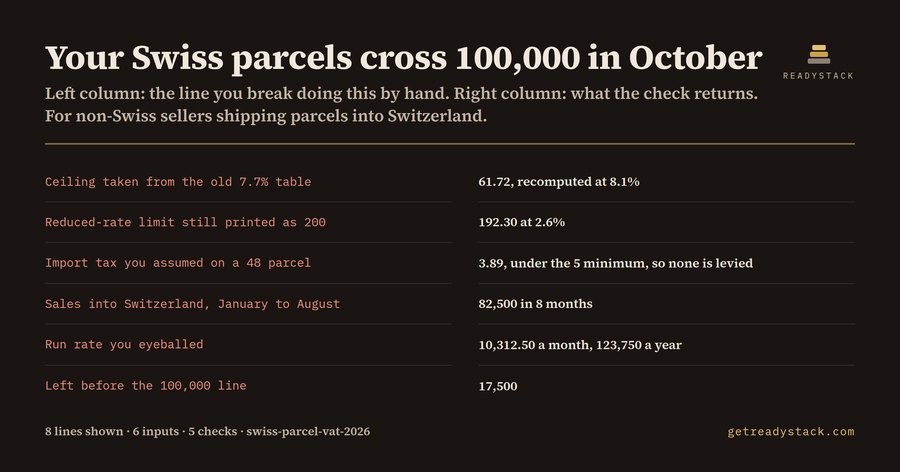
A German accessories seller shipping 48 CHF parcels into Switzerland crosses the CHF 100,000 mail-order line in October 2026 and has until 30 November 2026 to register with the Swiss Federal Tax Administration. Nothing on their dashboard says so.
Two numbers decide whether a non-Swiss online seller owes Swiss VAT, and both are usually wrong.
The first is the small-consignment ceiling. Switzerland does not levy import tax when the tax itself would be CHF 5 or less. That is a rule about the tax, not the goods. So the ceiling is CHF 5 divided by the VAT rate, and it moved when the rates moved on 2024-01-01. At the 8.1% standard rate the ceiling is CHF 61.72. At the 2.6% reduced rate it is CHF 192.30. At the 3.8% accommodation rate, CHF 131.57.
Almost every shipping guide and chatbot still prints CHF 65 and CHF 200, from the 7.7% and 2.5% rates repealed on 2024-01-01. A seller pricing to the old CHF 65 line is shipping parcels they believe are exempt across a border where they are not.
The second number is your own run rate, and no static guide can know it. A seller stays exempt only while annual turnover from import-tax-free small consignments stays under CHF 100,000. Above it, they count as a domestic supplier: registration with the Federal Tax Administration is required within 30 days of crossing, and from then every consignment - not only the small ones - carries Swiss MWST.
Here is the arithmetic on a real build. Feed in a 48 CHF order at the standard rate, 82,500 of small-consignment sales year to date, and 8 months completed. The check returns a ceiling of 61.72; import tax of 3.89, under the CHF 5 minimum, so none is levied; a run rate of 10,312.50 a month; a projection of 123,750; 17,500 left before the line; a crossing in October 2026; a deadline of 30 November 2026; and 1,670.63 of Swiss VAT falling on the November and December parcels - VAT nobody added to those prices.
Change the goods and the answer changes. A UK bookshop sending 34 CHF orders at the 2.6% reduced rate gets a ceiling of 192.30, a run rate of 5,125 against 41,000 year to date, a projection of 61,500, and no crossing in 2026 at all. Same tool, different rate, different answer.
Change the seller and it changes again. A US seller with 210 CHF orders is already over the ceiling - Swiss import VAT of 17.01 at the border on every one - and at 96,000 over 8 months the crossing lands in September 2026, deadline 30 October 2026. If those sales run through a marketplace, the platform has been the deemed supplier since 2025-01-01 for its own transactions, but direct parcels still build the seller's own CHF 100,000.
Missing the crossing is not a paperwork problem. The Federal Tax Administration can impose import bans on an unregistered company's consignments, order the destruction of goods, and publish the names of the companies those measures hit. It surfaces as parcels stopped at the border and customers charged unexpectedly - refunds and chargebacks long before any tax assessment.
The comparison that matters: Swiss fiscal representation runs about CHF 1,500 to CHF 3,500 a year plus roughly CHF 500 to register. That cost is unavoidable once you cross. Discovering the crossing after the FTA does is the expensive version of the same year.
The check is a browser popup and a free web page running the same function, with no key and no sign-up for any of the arithmetic. The paid layer sits on a different axis - ownership and repetition: a dated CSV audit trail of every order you checked, and a reminder that fires before the 30-day deadline rather than after it.
Questions people ask
What does this check actually do?
It recomputes the Swiss small-consignment ceiling from the VAT rate you select, because the legal rule is that import tax of CHF 5 or less is not levied. At 8.1% that is CHF 61.72, at 2.6% CHF 192.30. It then turns your year-to-date sales into the month you cross CHF 100,000 and the date you must register.
Who is it for?
Non-Swiss online sellers shipping parcels into Switzerland from the EU, the UK or the US, and the bookkeepers who watch their thresholds. If you send low-value consignments to Swiss customers and have never registered with the Federal Tax Administration, this is the number that decides whether you must.
Why not just ask a chatbot or read a shipping guide?
Both still print CHF 65 and CHF 200. Those came from the 7.7% and 2.5% rates that ended on 2024-01-01; at today's 8.1% and 2.6% the real ceilings are CHF 61.72 and CHF 192.30. A guide also cannot date your crossing month, because that depends on your own run rate.
What is free and what needs the key?
Every calculation is free and unlimited: the ceiling, the parcel verdict, the run rate, the crossing month, the registration date and the VAT exposure. The paid key adds a different axis entirely, ownership and repetition: a dated CSV audit trail you keep, and a reminder that fires before the 30-day deadline.
What would this cost me otherwise?
Swiss fiscal representation runs about CHF 1,500 to CHF 3,500 a year plus roughly CHF 500 for the registration itself. That bill is unavoidable once you cross, but paying it a quarter early, or discovering the crossing after the Federal Tax Administration does, is the expensive version.
Ask about this tool
One question, answered by the person who built it. Your email only if you want the answer sent.